Tuesday Terror – Black Sunday

Black Sunday (1961)
Sometimes Satan, with his capacity for doing evil, even plays tricks with the dead.

blacksunday barbara steele
 Black Sunday ©Kino International

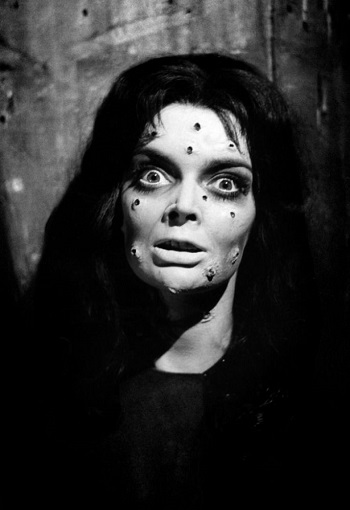
After following in his father’s footsteps, cinematographer Mario Bava made his directorial debut with 1960 gothic horror, Black Sunday, aka, The Mask of Satan, about a witch named Asa Vajda from Moldavia, who vows revenge after she and her apprentice are condemned to death by her brother, the crown prince. Two centuries later, on Black Sunday, the day Satan walks the earth, a traveling physician and his assistant unwittingly bring the witch back to life. After turning her apprentice into a vampire, Asa immediately sets out to fulfill her cursed prophecy, by terrorizing her brother’s descendants.


Production started in late March 1960 and took less than two months to film, releasing in Italy in August of 1960. The film was a modest success, bringing in $140 million lire, earning back its production costs, but performed much better in Europe and the US. Despite being low-budget, Black Sunday was praised for its originality and vivid imagery, however, the gore and gruesome violence shown in the film drew much criticism and was even banned in the UK until 1968, when a heavily censored version, retitled as Revenge of the Vampire, was finally released. The uncut version wouldn’t be shown until 1992!


In the US, Black Sunday was shown as a double feature with Roger Corman’s The Little Shop of Horrors in February 1961. In order to make the film less objectionable, American censors edited the movie down three minutes, excluding such violent scenes as, the burning and branding of flesh, eyeball impalement, and blood spewing out from the mask as it was hammered onto witch’s face in the opening sequence.


Unknown British actress Barbara Steele was cast in the lead duel role of the evil witch vampire Asa and her innocent descendant Katia. Even though her voice was dubbed by another actress, audiences swooned over Steele’s haunting beauty and loved her villainous portrayal of the vengeful Asa. Barbara Steele reportedly had a hard time on set and gained reputation for being difficult, mostly due in part to the lack of communication and language barrier.

BlackSundayposter
©Kino International

What was once shocking to audiences of the early sixties, holds the same magic to influence numerous artists and filmmakers over the years, including Francis Ford Coppola, who is said to have recreated several scenes in Bram Stoker’s Dracula, as a homage to Bava, and Tim Burton’s Sleepy Hollow, which borrowed imagery, namely, the iconic death by iron maiden scene. The horrifying story of revenge and all its extreme violence and sexual suggestions actually helped Black Sunday become a cult classic.
Black Sunday
©Kino International

Haiku of the Week

choking on a scream
hell’s hands pull me down
night terrors

Poe Sundays

Conqueror Worm*
by Edgar Allan Poe
(1843)

Lo! ’tis a gala night

Within the lonesome latter years!
An angel throng, bewinged, bedight
In veils, and drowned in tears,
Sit in a theatre, to see
A play of hopes and fears,
While the orchestra breathes fitfully
The music of the spheres.

Mimes, in the form of God on high,
Mutter and mumble low,
And hither and thither fly-
Mere puppets they, who come and go
At bidding of vast formless things
That shift the scenery to and fro,
Flapping from out their Condor wings
Invisible Woe!

That motley drama- oh, be sure
It shall not be forgot!
With its Phantom chased for evermore,
By a crowd that seize it not,
Through a circle that ever returneth in
To the self-same spot,
And much of Madness, and more of Sin,
And Horror the soul of the plot.

But see, amid the mimic rout
A crawling shape intrude!
A blood-red thing that writhes from out
The scenic solitude!
It writhes!- it writhes!- with mortal pangs
The mimes become its food,
And seraphs sob at vermin fangs
In human gore imbued.

Out- out are the lights- out all!
And, over each quivering form,
The curtain, a funeral pall,
Comes down with the rush of a storm,
While the angels, all pallid and wan,
Uprising, unveiling, affirm
That the play is the tragedy, ‘Man,’
And its hero the Conqueror Worm.


*Reading along with horror icon Vincent Price is quite haunting.

Sinister Saturdays – Halloween Buffalo Chicken Skillet Dip

Halloween parties are a tradition dating back to ancient times, when the Samhain festival kicked off to celebrate the end of the harvest season. In the early days of America, that was the only way to celebrate Halloween.

Make your party a spooktacular success with this great dip recipe from Tasty.co, who share their quick and simple recipe for Halloween Buffalo Chicken Skillet Dip

halloween buffalo chicken skillet dip
Screenshots by Tasty.co
Ingredients (12 Servings)
  • 2 cups chicken, cooked and shredded
  • 8 ounces cream cheese, softened
  • ½ cup monterrey jack cheese
  • ⅔ cup cheddar cheese
  • ½ cup buffalo sauce
  • ½ cup ranch dressing
  • 2 tubes refrigerated pizza dough
  • 4 ounce block cheddar cheese, cubed
  • 2 tablespoons melted butter


For preparation instructions and video, please go here:
https://tasty.co/recipe/halloween-buffalo-chicken-skillet-dip

buffalochickenskilletdip4
Screenshots by Tasty.co

Let’s get this party started!

Friday Fright Nightcaps – Zombtini

Who doesn’t love a good zombie story?  Today, we celebrate the return of Columbus, Tallahassee, Wichita and Little Rock, a group of survivors struggling to stay alive in zombie ravaged America, in the horror-comedy Zombieland: Double Tap.

Let’s be honest, most Americans feel like total zombies at the end of long work week. We could use a good pick-me-up to bring back some color to our cheeks. The folks over at Totally the Bomb know what it takes to blow us away with a great new take on the classic martini. May I present, the Zombtini

zombtini
Zombtini Photos by TotallytheBomb.com

Ingredients:

  • 1 oz. Captain Morgan White Rum
  • 2 oz. Dekuyper Melon Liqueur
  • 1 oz. 100% Pineapple Juice
  • 0.5 oz. Sprite
  • Dash of Grenadine (garnish)
zombtini 3
Zombtini Photos by TotallytheBomb.com


For full mixing instructions, please go here: https://totallythebomb.com/make-your-own-zombtini

For those of you with one foot in the grave, remember to drink responsibly.

Copy of Friday Fright Nightcaps

The Witch’s Tale, American Radio’s First Horror Show

The Witch’s Tale was the first horror-fantasy radio series, which aired from May 28, 1931, to June 13, 1938, on WOR, the Mutual Radio Network, and later in syndication. Creator Alonzo Deen Cole, a 34-year old Minnesota native, convinced the station to air the supernatural series that he wrote and directed himself. His goal was to draw audiences away from more conventional musical shows airing on rival stations.

Witchs_Tale_1The creepy 30-minute weekly anthology featured a cackling host named Old Nancy, a witch from Salem, who, along with her wise black cat named Satan, spun a new wicked “bedtime yarn” each week. The show terrified younger listeners and was a huge success with New York children, who adored Old Nancy, often imitating her cackles and quips, in efforts to scare younger siblings.

The shows were broadcast live, recorded for syndication, and then distributed to various national markets. It’s reported, that in 1961, Cole didn’t think the recordings held any value, so he destroyed nearly all of them (only about 30-50 recordings exist today).

Witchs Tale trio
Most scripts were original stories but there were a few literary adaptions as well. Cole played the cat Satan and enlisted the aid of his wife Marie O’Flynn to play lead female characters. Old Nancy, liked telling tales was created by stage actress Adelaide Fitz-Allen, who portrayed the spooky witch until her death in 1935.Auditions were held soon after to find a new Old Nancy and 13-year old Miriam Wolfe, a radio prodigy from Brooklyn, New York was chosen for the role after Cole heard the girl mimicking the character’s trademark cackling laugh. Wolfe would play the character for several years, in addition to other characters, before leaving to pursue other interests. Veteran radio and film actress Martha Wentworth (the famed Disney voice artist) then stepped in to lend her voice talents as Old Nancy. Top New York radio actors were often cast to fill roles of secondary characters respectively.


In 1936, a companion magazine called The Witch’s Tales was published by the small firm, Carwood Publishing Co., which reportedly failed to promote the radio show properly and completely mismanaged finances and distribution of the magazine. Only two issues (November and December) ever made it into print. Although Alonzo Deen Cole was named editor, real editorial work was believed to be done by Tom Chadburn. Cole did, however, write the lead story for the first issue and contributed the plot for the main story in the second issue. The magazine’s other stories were all reprints from the American version of Pearson’s Magazine. 

The spell cast by The Witch’s Tale came to an end in 1958, with talk of bringing the series to television. Cole was eyed as a consultant and story supervisor for the pilot, but the idea never came to fruition.

You can find many episodes over at Archive.org: https://archive.org/details/TheWitchsTale

The video shown below is titled Graveyard Mansion, originally aired in 1934, about two brothers who may have stumbled upon a New Orleans vampire. Take a listen.

Wicked Art Wednesdays – Robb Mommaerts

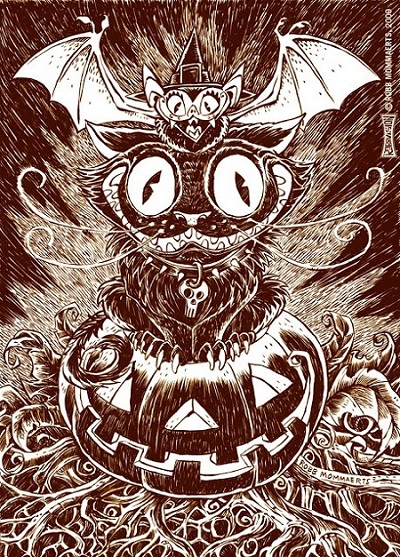
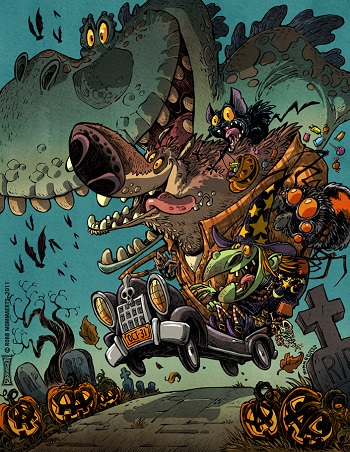
Hailing from the midwest, uber-talented illustrator/graphic designer Robb Mommaerts, started drawing at the tender age of two, finding inspiration in Disney, Looney Tunes, the Muppets, children’s books and comics. He spent many years working as a professional graphic designer before setting out on his own in freelance illustration, creating for such companies as Cryptozoic, Boom! Entertainment, and Image Comics, just to name a few.

ween_racers_ink_blog rmommaerts

Website: http://robbvision.blogspot.com/
Deviant Art Gallery: https://www.deviantart.com/robbvision/gallery
Social Media: https://www.instagram.com/robbmommaerts and https://twitter.com/robbmommaerts1

Why we love them: Robb Mommaerts loves monsters.  The creator of Robbvision (currently on hiatus) cites Halloween as his second favorite holiday, next to Christmas (btw, you should totally check out his Xmas work). Robb’s images capture the whimsical fun of Halloween and feature zany characters that both adults and children can love.

Tuesday Terror – Curse of Frankenstein

Curse of Frankenstein (1957)
I’ve harmed nobody, just robbed a few graves!

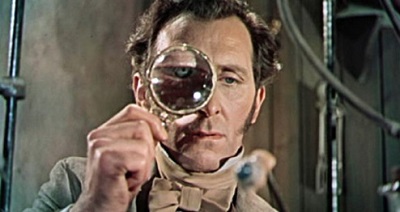
curse 3
Curse of Frankstein ©Hammer Film Productions

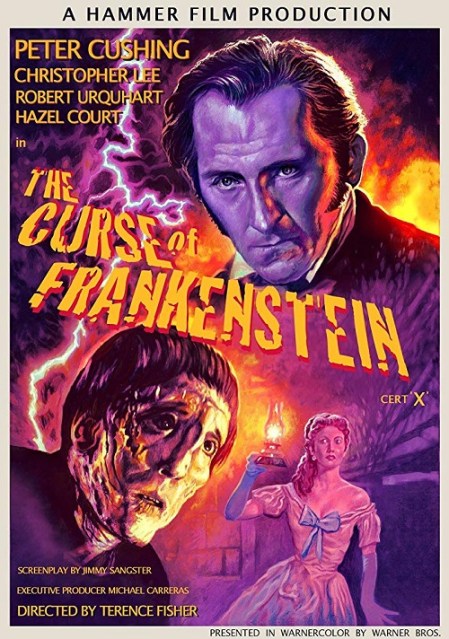
Hammer Film’s first incursion into the Frankenstein mythos, Curse of Frankenstein, spawned several sequels, all of them starring soon-to-be horror icon Peter Cushing as Victor Frankenstein.  Directed by Terence Fisher, in what would be the first of many films that Fisher would make for Hammer Films, the film also starred a young Christopher Lee, playing the Monster, before he would go on to don Dracula’s cape for the next three decades.

Universal Films fought vehemently to protect their own Frankenstein film and its rights, which reflected heavily on many decisions Hammer made during filming. Make-up artist Phil Leaky created a brand-new look for the monster, and several key scenes from the novel were cut due to a limited budget. Despite its limitations, Curse of Frankenstein impressed many with its art direction, costuming, camera work, and the stellar cast, which also included English actor Hazel Court, (just starting out in her lengthy career as a horror queen), and Scottish stage and TV actor Robert Urquhart.


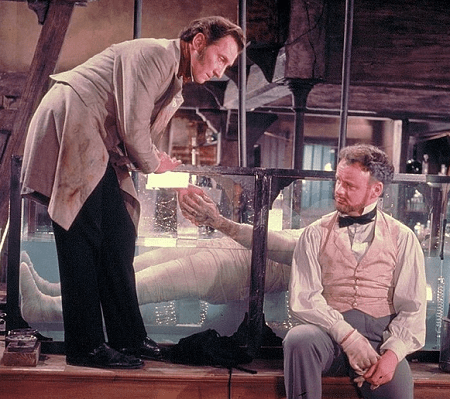
This story revolves around Frankenstein himself, rather than his creature, choosing to show the Baron as a more ambitious, egotistical and ruthless man; at the start of the story, he awaits execution for several murders. Hammer’s version of Dr. Frankenstein is a villainous man, willing to commit crimes, set up a man’s accidental death, aka murder, to obtain the parts he needs to create his creature, and even use the poor creature to kill opponents standing in the way of greatness. Since, the brain was damaged, it becomes apparent quickly that the monster has little intelligence and is too far too violent to control, thus, Frankenstein is forced to destroy his greatest creation. With the evidence gone, fate comes down to his younger associate Dr. Paul Krempe, the only witness to the experiments.

curse
©Hammer Film Productions

Colin Clive may have had the most memorable line in horror history, but it was Peter Cushing who was highly praised for the truly unforgettable performance of Victor Frankenstein, for fleshing out the character that audiences deemed charming and intriguing, in spite of his villainy. It was Cushing that helped inspire the mad scientist archetype and motivated Hammer to continue his story all the way into the 70s.

Curse of Frankenstein was Hammer’s first color film and considered by many to be the first truly gory film. The deep red blood and guts appeared gorier on screen than any other horror film of its time, causing a bit of uproar and scathing reviews. It even received an X rating for a time, when it opened at the London Pavilion in 1957. Despite receiving the lukewarm reviews from critics, audiences seemed to really like the film, grossing nearly $8 million, thus, putting Hammer Films squarely on the map.

curseoffrankensteinposter
Curse of Frankstein ©Hammer Film Productions


Haiku of the Week

broken stone
a lover, taken too soon
empty grave

Poe Sundays

The Sleeper
by Edgar Allan Poe
(published 1831)

At midnight, in the month of June,
I stand beneath the mystic moon.
An opiate vapor, dewy, dim,
Exhales from out her golden rim,
And, softly dripping, drop by drop,
Upon the quiet mountain top,
Steals drowsily and musically
Into the universal valley.
The rosemary nods upon the grave;
The lily lolls upon the wave;
Wrapping the fog about its breast,
The ruin molders into rest;
Looking like Lethe, see! the lake
A conscious slumber seems to take,
And would not, for the world, awake.
All Beauty sleeps!- and lo! where lies
Irene, with her Destinies!

O, lady bright! can it be right-
This window open to the night?
The wanton airs, from the tree-top,
Laughingly through the lattice drop-
The bodiless airs, a wizard rout,
Flit through thy chamber in and out,
And wave the curtain canopy
So fitfully- so fearfully-
Above the closed and fringed lid
‘Neath which thy slumb’ring soul lies hid,
That, o’er the floor and down the wall,
Like ghosts the shadows rise and fall!
Oh, lady dear, hast thou no fear?
Why and what art thou dreaming here?
Sure thou art come O’er far-off seas,
A wonder to these garden trees!
Strange is thy pallor! strange thy dress,
Strange, above all, thy length of tress,
And this all solemn silentness!

The lady sleeps! Oh, may her sleep,
Which is enduring, so be deep!
Heaven have her in its sacred keep!
This chamber changed for one more holy,
This bed for one more melancholy,
I pray to God that she may lie
For ever with unopened eye,
While the pale sheeted ghosts go by!

My love, she sleeps! Oh, may her sleep
As it is lasting, so be deep!
Soft may the worms about her creep!
Far in the forest, dim and old,
For her may some tall vault unfold-
Some vault that oft has flung its black
And winged panels fluttering back,
Triumphant, o’er the crested palls,
Of her grand family funerals-

Some sepulchre, remote, alone,
Against whose portal she hath thrown,
In childhood, many an idle stone-
Some tomb from out whose sounding door
She ne’er shall force an echo more,
Thrilling to think, poor child of sin!
It was the dead who groaned within.