Pumpkins are the most important element of the Halloween season. It is the symbol of Halloween itself. Pumpkin desserts have been getting a bad rap lately because of pricey, syrupy pumpkin spice drinks served at the coffee place that shall not be named, but pumpkins themselves are quite healthy, being high in potassium, vitamin C, fiber and antioxidants. So, remember to look up some creative ways to use leftover parts of your carved pumpkin this weekend.
Today is the last Friday in October, which means it’s National Frankenstein Friday! Weary from the work week? Well, give your system a jolt with a spookalicious drink to kick off the last big weekend of the Halloween season. Miss Information teaches us that science can be fun with this freaky good Frankenstein Cocktail.
People have been carving vegetables into lanterns since the dawn of time. The Maori people used gourds for lights, over 700 years ago. It’s believed the making of jack-o’-lanterns began in Ireland in 1600s, when they used turnips and gourds to hollow out to use for lantern during Halloween in Ireland and Scotland, sometimes carving out grotesque faces to frighten people.
The lanterns represented spirits and were used to ward off evil or lost spirits. Sometimes people put them on the windowsills to keep harmful spirits away from the home. Once Christianity took firm hold in the region and Halloween combined with the Christian observances of All Saints’ Day on November 1 and All Souls’ Day on November 2, jack-o’-lanterns were lit in remembrance of Christian souls in purgatory.
The term Jack-o’-Lantern began showing up in print in the early 1800s, when Irish newspapers began printing stories telling of carved gourd lanterns and information on local gourd carving competitions. But it wasn’t until 1866, that the first recorded association between a carved pumpkin and Halloween would show up in an edition of The Daily News in Kingston, Ontario.
Today’s jack-o’-lanterns have evolved into works of art. No longer content with simple faces, pumpkin carving has become big business with the sale of tools and artistic guides to help amateurs and home haunters create their own elaborately designed pumpkins, to televised competitions and special appearances by professional carvers, who enjoy D-List celebrity status.
Will-o’-the-Wisp
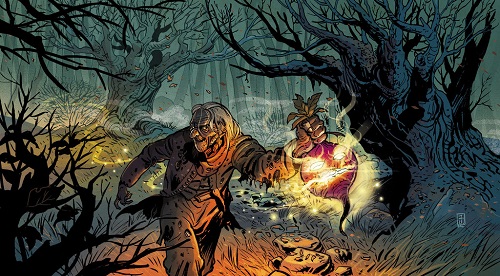
Jack-o’-Lanterns were once associated with the term ‘will-o’-the-wisp’ or ‘ignis fatuus’, the Medieval Latin for “fool’s fire”. A will-o’-the-wisp was thought to be a ghostly light or orb seen by travelers during the night, particularly near bogs, swamps, or marshes. The phenomenon was said be supernatural, brought on by ghosts, fairies, or other elemental spirits.
A tale behind the term refers to a wicked blacksmith who was turned away at the pearly gates by St. Peter. He was given a second chance to redeem himself but the blacksmith failed to change his evil ways and was then cursed to wander the earth for eternity. The Devil was impressed by the blacksmith’s antics and decided to give him a single burning coal to keep him warm, which he used to lure foolish travelers into the marshes instead.
The Story of Stingy Jack
In addition to the will-o’-the-wisp myth, no folklore associated with jack-o’-lanterns are quite as memorable as the story of Stingy Jack, a devilish man, so evil, the real Satan paid him a visit to see what all the hoopla was about. The witty Jack was a shrewd deceiver, a master manipulator and a nasty drunkard, who managed to trick Satan, not once but twice. The first time, he convinced the devil to go drinking with him. Afterward, being too stingy to pay, Jack told the Devil to turn into a coin so he can pay the bill. Once the Devil did so, Jack put the coin in his pocket along with a silver cross, trapping Satan until he agreed to spare Jack’s soul for ten years. The Devil agree and off Jack went.
by surrounding the devil with crosses to trap him until he agreed to spare Jack’s soul. Once Jack finally died from drink, he was refused entrance into heaven for his lifetime of sin and denied entrance into hell per his previous agreement with Satan. Satan cast the doomed soul out to wander the world for eternity, with only a single ember, which Jack inserted into a hollowed turnip to light his way. He became known as Jack of the Lantern, and eventually, Jack-o’-Lantern.
New Jersey native William Basso grew up in a home, surrounded by art, courtesy of his parents, who were both artists. After graduating with a degree in illustration from Parsons School of Design, he moved to California to work on special effects in the movie industry, lending his talents to such blockbusters as Jurassic Park, Terminator 2, Edwards Scissorhands.
Influenced by comics, horror and Renaissance and Eastern European art, his artwork is a combination of mixed media including drawing, sculpture, and photography, among others. Vivid in detail and heaving with emotion, Basso’s art tells stories though his character creations, not unlike something you’d find in a stage play.
Why we love them: Basso’s ornate art usually incorporates light, pale or soft colors, which slowly draw viewers into his strange and creepy world, which is sometimes gruesome, but not jarring or in your face. It’s a subtle morbidness that allows our lingering curiosity to play out naturally.
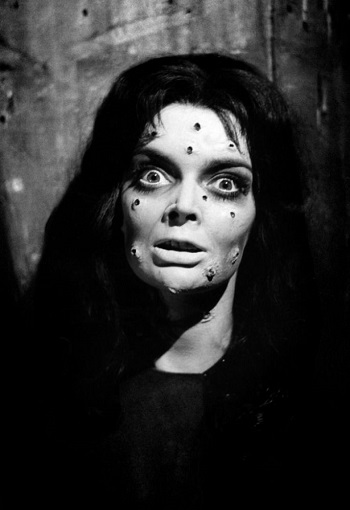
After following in his father’s footsteps, cinematographer Mario Bava made his directorial debut with 1960 gothic horror, Black Sunday, aka, The Mask of Satan, about a witch named Asa Vajda from Moldavia, who vows revenge after she and her apprentice are condemned to death by her brother, the crown prince. Two centuries later, on Black Sunday, the day Satan walks the earth, a traveling physician and his assistant unwittingly bring the witch back to life. After turning her apprentice into a vampire, Asa immediately sets out to fulfill her cursed prophecy, by terrorizing her brother’s descendants.
Production started in late March 1960 and took less than two months to film, releasing in Italy in August of 1960. The film was a modest success, bringing in $140 million lire, earning back its production costs, but performed much better in Europe and the US. Despite being low-budget, Black Sunday was praised for its originality and vivid imagery, however, the gore and gruesome violence shown in the film drew much criticism and was even banned in the UK until 1968, when a heavily censored version, retitled as Revenge of the Vampire, was finally released. The uncut version wouldn’t be shown until 1992!
In the US, Black Sunday was shown as a double feature with Roger Corman’s The Little Shop of Horrors in February 1961. In order to make the film less objectionable, American censors edited the movie down three minutes, excluding such violent scenes as, the burning and branding of flesh, eyeball impalement, and blood spewing out from the mask as it was hammered onto witch’s face in the opening sequence.
Unknown British actress Barbara Steele was cast in the lead duel role of the evil witch vampire Asa and her innocent descendant Katia. Even though her voice was dubbed by another actress, audiences swooned over Steele’s haunting beauty and loved her villainous portrayal of the vengeful Asa. Barbara Steele reportedly had a hard time on set and gained reputation for being difficult, mostly due in part to the lack of communication and language barrier.
What was once shocking to audiences of the early sixties, holds the same magic to influence numerous artists and filmmakers over the years, including Francis Ford Coppola, who is said to have recreated several scenes in Bram Stoker’s Dracula, as a homage to Bava, and Tim Burton’s Sleepy Hollow, which borrowed imagery, namely, the iconic death by iron maiden scene. The horrifying story of revenge and all its extreme violence and sexual suggestions actually helped Black Sunday become a cult classic.
Within the lonesome latter years!
An angel throng, bewinged, bedight
In veils, and drowned in tears,
Sit in a theatre, to see
A play of hopes and fears,
While the orchestra breathes fitfully
The music of the spheres.
Mimes, in the form of God on high,
Mutter and mumble low,
And hither and thither fly-
Mere puppets they, who come and go
At bidding of vast formless things
That shift the scenery to and fro,
Flapping from out their Condor wings
Invisible Woe!
That motley drama- oh, be sure
It shall not be forgot!
With its Phantom chased for evermore,
By a crowd that seize it not,
Through a circle that ever returneth in
To the self-same spot,
And much of Madness, and more of Sin,
And Horror the soul of the plot.
But see, amid the mimic rout
A crawling shape intrude!
A blood-red thing that writhes from out
The scenic solitude!
It writhes!- it writhes!- with mortal pangs
The mimes become its food,
And seraphs sob at vermin fangs
In human gore imbued.
Out- out are the lights- out all!
And, over each quivering form,
The curtain, a funeral pall,
Comes down with the rush of a storm,
While the angels, all pallid and wan,
Uprising, unveiling, affirm
That the play is the tragedy, ‘Man,’
And its hero the Conqueror Worm.
*Reading along with horror icon Vincent Price is quite haunting.
Halloween parties are a tradition dating back to ancient times, when the Samhain festival kicked off to celebrate the end of the harvest season. In the early days of America, that was the only way to celebrate Halloween.
Who doesn’t love a good zombie story? Today, we celebrate the return of Columbus, Tallahassee, Wichita and Little Rock, a group of survivors struggling to stay alive in zombie ravaged America, in the horror-comedy Zombieland: Double Tap.
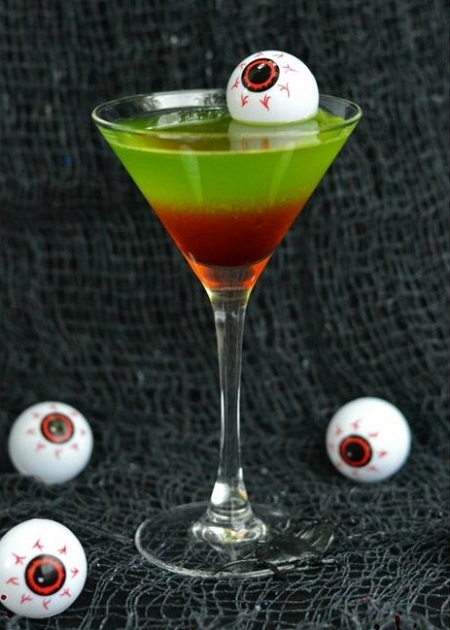
Let’s be honest, most Americans feel like total zombies at the end of long work week. We could use a good pick-me-up to bring back some color to our cheeks. The folks over at Totally the Bomb know what it takes to blow us away with a great new take on the classic martini. May I present, the Zombtini
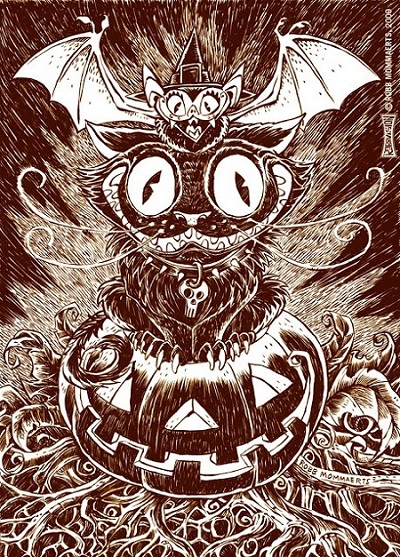
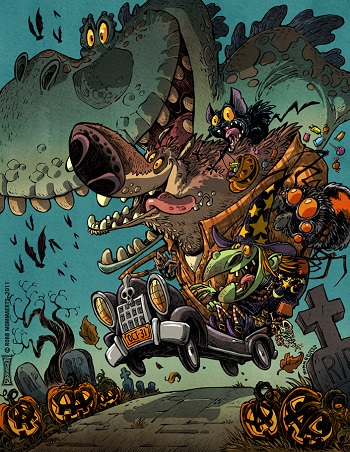
Hailing from the midwest, uber-talented illustrator/graphic designer Robb Mommaerts, started drawing at the tender age of two, finding inspiration in Disney, Looney Tunes, the Muppets, children’s books and comics. He spent many years working as a professional graphic designer before setting out on his own in freelance illustration, creating for such companies as Cryptozoic, Boom! Entertainment, and Image Comics, just to name a few.
Why we love them: Robb Mommaerts loves monsters. The creator of Robbvision (currently on hiatus) cites Halloween as his second favorite holiday, next to Christmas (btw, you should totally check out his Xmas work). Robb’s images capture the whimsical fun of Halloween and feature zany characters that both adults and children can love.




 Influenced by comics, horror and Renaissance and Eastern European art, his artwork is a combination of mixed media including drawing, sculpture, and photography, among others. Vivid in detail and heaving with emotion, Basso’s art tells stories though his character creations, not unlike something you’d find in a stage play.









 Halloween Horror Haiku
You must be logged in to post a comment.