Trick or Treat Tuesday: Night of the Living Dead (1968)

Full-length, remastered HD version of Night of the Living Dead,
directed by George A. Romero, brought to us by Public Domain Films

Ever wonder how the most popular zombie film of all time, Night of the Living Dead ended up in U.S. public domain? Well, it happened after the original theatrical distributor, Walter Reade Organization, failed to replace a necessary copyight notice on the title card of the print of the film, after changing the movie’s title from Night of the Flesh Eaters to Night of the Living Dead.(1) 

According to U.S. copyright laws, any work made or published before 1923 automatically enters the public domain. According to the 1909 Copyright Act, all creative works needed to have a sufficient copyright notice. That’s why most works are accompanied by the following symbol © and a year.(2) The act has since been updated, but at the time of its release, Night of the living Dead needed to follow this simple rule. 

As a result of the distribution company’s error, George A. Romero immediately lost the rights to his film, and subsequently, millions of dollars in lost revenue, advertising and merchandising. In fact, up until Night of the Living Dead, zombie movies were about mind-controlled humans through manipulation, sorcery or voodoo. Romero was actually the first to create an undead flesh-eating creature that preys on the living. So, we can pretty much speculate that if Romero had retained the rights to Night of the Living Dead, every zombie book, film, TV and video game would have been controlled by George A. Romero.

Romero often expressed that losing the rights to his first feature film was one of his biggest regrets. The famed horror director passed away in 2017, after watching his creation grow into a monsterous sub-genre of horror. Strangely enough, Night of the Living Dead falling into public domain helped make zombies more popular, inspired creativity across the globe, helped spawn several horror franchises, and even launched the careers of some of today’s best horror directors. The entire zombie industry owes a debt of gratitude for its existence to this man. Maybe the universe knew the power to control zombies was too big a task for one human being.

It all worked out for George A. Romero too. As zombie popularity grew, Romero earned more opportunities to make movies, created projects, wrote books and comics, and even capitalized on his own notoriety as the “king of the zombie films.” In 1999, Night of the Living Dead was added to the U.S. National Film Registry for its historical and cultural significance.

Source Material:
1) https://en.wikipedia.org/wiki/Night_of_the_Living_Dead
2) https://www.copyright.gov/circs/circ15a.pdf
Halloween Cartoons in Public Domain

According to US law, all motion pictures made and exhibited before 1923 are in public domain, but copyright law is seriously complex and since other countries have different copyright laws than the USA, it can be downright confusing when trying to get correct information. Shepherded works from golden age of American animation typically fell into public domain due to registration failures, clerical errors, or a variety of other personal and business reasons. Recently, I was researching Halloween cartoons in public domain and I thought I’d share my research on three of the most commonly misidentified Halloween cartoons.

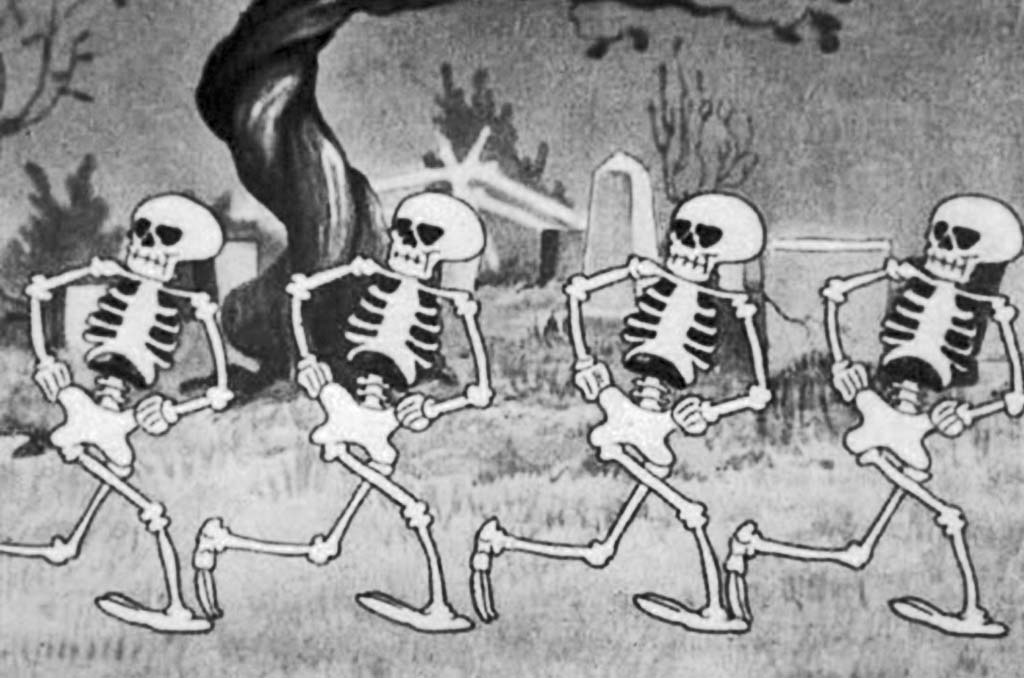
  1. Disney’s Silly Symphonies Skeleton Dance, 1929

Despite what you may have heard or seen online, the Skeleton Dance is not public domain, likewise, neither is Mickey Mouse’s Haunted House. Due to the Copyright Term Extension Act of 1998 (CTEA), copyright protection was extended 95 years from the publication date for any works published before January 1, 1978. That meant, any films released in 1923, which would have entered public domain in 1998, were scheduled to enter on January 1, 2019. Due to extensive lobbying, the Walt Disney Company was granted more extension for their works, therefore, all early Mickey Mouse cartoons, such as Steamboat Willie, won’t enter public domain until 2023. Keep in mind, there’s a very good chance that Disney will be granted another extension. Thus, why some people refer to CTEA as the ‘Mickey Mouse Protection Act’.

It’s important to note, that all Disney characters are not only copyrighted but also trademarked and that lasts for forever, so long as the owners continually use the trademarks commercially. Bottom line, Disney characters may NOT be commercially used whether they’re part of the public domain or not.

skeleton_dance

  1. Betty Boop’s Halloween Party, 1933

Betty Boop’s Halloween Party is not in public domain. Since the Copyright Act of 1976, copyrights are automatically applied to a work and last the entirety of someone’s life, plus 95 years after creator’s death. Before 1976, however, companies needed to register and re-register their works to ensure copyright protection. In the case of Betty Boop, after a few company mergers and failure of the original owners, Fleischer Studios, to re-register the copyright of many of Betty Boop’s earliest cartoons, many fell into public domain. Unfortunately for fans, Halloween Party is not one of them.  Wikipedia has a comprehensive list of Betty Boop’s cartoons and indicates which ones are public domain.

For the record, it appears that the character of Betty Boop is owned by Paramount, the Betty Boop name itself is owned by Fleischer Studios, and the right to distribute the cartoons (those not public domain) are split between three different companies, Trifeca Entertainment & Media, Olive Films and Melange Pictures.

betty boop halloween party

  1. Casper, The Friendly Ghost, 1945

Casper’s very first movie The Friendly Ghost is public domain. In the 1950s, when Harvey Publications purchased Casper the Friendly Ghost and bunch of other cartoons from Noveltoon, lawyers failed to inform Harvey that they needed to register copyrights for the first works of the character, thus, The Friendly Ghost and four other Casper titles (There’s Good Boos To-Night, A Haunting We Will Go Boo Moon, and Spooking About Africa) all wound up in public domain, however, these are the only works that are public domain. Because Harvey trademarked Casper and continued to make newer cartoons, they retained ownership of the character of Casper and all subsequent Casper works. These days, Universal Studios holds ownership over Casper and all films except for the five mentioned above.

Here are a few more spooky cartoons in public domain:

Felix the Cat, Switches Witches 1927
Swing You Sinners 1930
Bimbo’s Initiation 1931
The Mad Doctor 1933
The Headless Horseman 1934
Cobweb Hotel 1936
Popeye, Fright to the Finish 1954

The-mad-doctor-movie-poster-1020197769
This is one of the very few Disney cartoons they let slip into public domain. It’s considered too dark and violent for their programming

I’m not a legal expert, so please don’t assume any of this is legal advice. Please seek out your own legal counsel and do your research before posting potentially copyrighted or trademarked material on websites.

If you’re interested in more animation films in public domain, check out TV Tropes and Wikipedia, which both have a pretty comprehensive list of films.

http://tvtropes.org/pmwiki/pmwiki.php/Main/PublicDomainAnimation

https://en.wikipedia.org/wiki/List_of_animated_films_in_the_public_domain_in_the_United_States