I saved the best for last. If you ever hear a Cyndi Lauper song in a horror film, this is peak 80s in all its surreal neon day-glowiness!
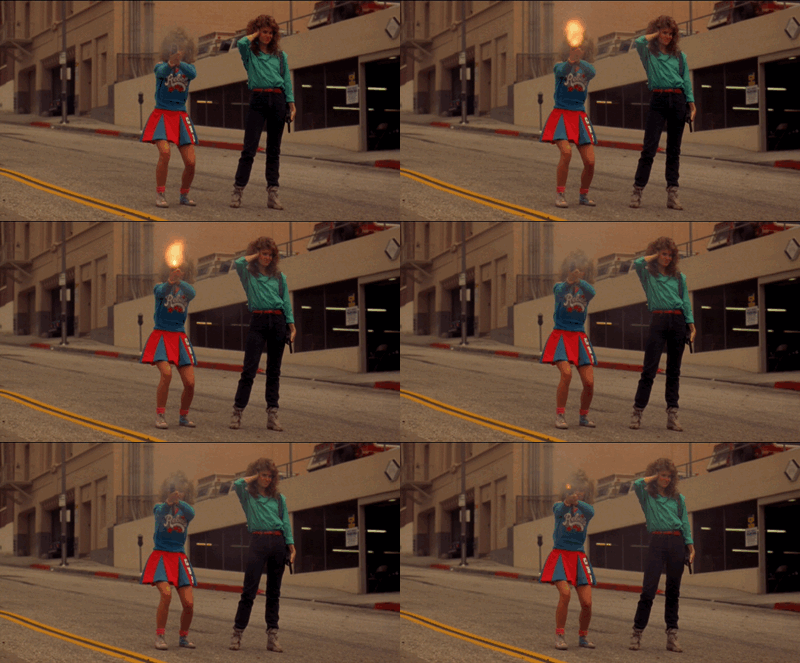
At face value, Night of the Comet is a mindless mash-up of several low-budget B-movie horror Sci-fi gems from the 50-60s, but look closer, and you’ll see Writer-director Thom Eberhardt actually penned a smart, witty satire, in tribute of such fine films. The question asked, what happens when two valley girls are the only two people left after a comet wipes off everyone on the planet? If your first guess was ‘they go mall shopping and then get attacked by zombies’, give yourself a prize!
Two sisters Regina and Samantha played by Catherine-Mary Stewart and Kelli Maroney, are more than just gum popping, ripped-denim, leg warmer wearing bimbos full of sass. As if! They’re actually pretty smart, and they manage to fight off armed invaders with Uzis in a sinister turf war, blood-seeking evil scientists with one-foot in the grave, and of course, comet-induced flesh-eating zombies, that always seem to come outta nowhere, all while working through why always-absent daddy married that money-hungry bitch Doris. Level one up for the ladies of the eighties!
It’s true, there’s a lot of “family drama” with our feather-haired heroes, and less zombies than an average Walking Dead episode these days, but there’s still plenty of fun-filled comedy and bursts of non-gory action. That’s right, no gore in this one, which is probably while the movie missed its mark as a really great horror film, but horror fanatics can’t live on blood-splatter alone. We need something to break up the monotony. If your eighties Halloween movie marathon contains Nightmare on Elm Street, any Hellraisers or early Maniacs, or John Carpenter’s The Thing, consider throwing in this campy zombie romp as a breather. You’ll thank me later.
Poe Sundays are all about honoring the works of Edgar Allan Poe. The Black Cat can be a tough read for many, as there’s quite a bit of animal cruelty, but that does play a part in the story and why it’s considered one of the most frightening short stories ever written. This blog does not condone the act of animal cruelty, nor do I believe that was the author’s intention.
The Black Cat by Edgar Allan Poe (published 1845)
For the most wild, yet most homely narrative which I am about to pen, I neither expect nor solicit belief. Mad indeed would I be to expect it, in a case where my very senses reject their own evidence. Yet, mad am I not — and very surely do I not dream. But to-morrow I die, and to-day I would unburthen my soul. My immediate purpose is to place before the world, plainly, succinctly, and without comment, a series of mere household events. In their consequences, these events have terrified — have tortured — have destroyed me. Yet I will not attempt to expound them. To me, they have presented little but Horror — to many they will seem less terrible than barroques. Hereafter, perhaps, some intellect may be found which will reduce my phantasm to the common-place — some intellect more calm, more logical, and far less excitable than my own, which will perceive, in the circumstances I detail with awe, nothing more than an ordinary succession of very natural causes and effects.
From my infancy I was noted for the docility and humanity of my disposition. My tenderness of heart was even so conspicuous as to make me the jest of my companions. I was especially fond of animals, and was indulged by my parents with a great variety of pets. With these I spent most of my time, and never was so happy as when feeding and caressing them. This peculiarity of character grew with my growth, and, in my manhood, I derived from it one of my principal sources of pleasure. To those who have cherished an affection for a faithful and sagacious dog, I need hardly be at the trouble of explaining the nature or the intensity of the gratification thus derivable. There is something in the unselfish and self-sacrificing love of a brute, which goes directly to the heart of him who has had frequent occasion to test the paltry friendship and gossamer fidelity of mere Man.
I married early, and was happy to find in my wife a disposition not uncongenial with my own. Observing my partiality for domestic pets, she lost no opportunity of procuring those of the most agreeable kind. We had birds, gold-fish, a fine dog, rabbits, a small monkey, and a cat.
This latter was a remarkably large and beautiful animal, entirely black, and sagacious to an astonishing degree. In speaking of his intelligence, my wife, who at heart was not a little tinctured with superstition, made frequent allusion to the ancient popular notion, which regarded all black cats as witches in disguise. Not that she was ever serious upon this point — and I mention the matter at all for no better reason than that it happens, just now, to be remembered.
Pluto — this was the cat’s name — was my favorite pet and playmate. I alone fed him, and he attended me wherever I went about the house. It was even with difficulty that I could prevent him from following me through the streets.
Our friendship lasted, in this manner, for several years, during which my general temperament and character — through the instrumentality of the Fiend Intemperance — had (I blush to confess it) experienced a radical alteration for the worse. I grew, day by day, more moody, more irritable, more regardless of the feelings of others. I suffered myself to use intemperate language to my wife. At length, I even offered her personal violence. My pets, of course, were made to feel the change in my disposition. I not only neglected, but ill-used them. For Pluto, however, I still retained sufficient regard to restrain me from maltreating him, as I made no scruple of maltreating the rabbits, the monkey, or even the dog, when by accident, or through affection, they came in my way. But my disease grew upon me — for what disease is like Alcohol ! — and at length even Pluto, who was now becoming old, and consequently somewhat peevish — even Pluto began to experience the effects of my ill temper.
One night, returning home, much intoxicated, from one of my haunts about town, I fancied that the cat avoided my presence. I seized him; when, in his fright at my violence, he inflicted a slight wound upon my hand with his teeth. The fury of a demon instantly possessed me. I knew myself no longer. My original soul seemed, at once, to take its flight from my body; and a more than fiendish malevolence, gin-nurtured, thrilled every fibre of my frame. I took from my waistcoat-pocket a pen-knife, opened it, grasped the poor beast by the throat, and deliberately cut one of its eyes from the socket! I blush, I burn, I shudder, while I pen the damnable atrocity.
When reason returned with the morning — when I had slept off the fumes of the night’s debauch — I experienced a sentiment half of horror, half of remorse, for the crime of which I had been guilty; but it was, at best, a feeble and equivocal feeling, and the soul remained untouched. I again plunged into excess, and soon drowned in wine all memory of the deed.
The Fall of the House of Usher by Edgar Allan Poe (1839)
Poe Sundays are all about honoring the works of Edgar Allan Poe. The Fall of the House of Usher is considered by many critics to be Poe’s gothic masterpiece. Despite never learning the name of the story’s narrator, we come to quickly trust his well-observed eye and candor about the events experienced during his journey to visit Roderick Usher, a boyhood friend, of whom he has not seen in quite some time. It begins with an epigraph from French poet Jean Pierre de Beranger, which translates to “His heart is a tightened lute; as soon as one touches it, it echoes.” The narrator wastes no time in suggesting to his audience that Usher and the crumbling mansion share the same doomed fate.
Son cœur est un luth suspendu; Sitôt qu’on le touche il résonne. De Béranger.
DURING the whole of a dull, dark, and soundless day in the autumn of the year, when the clouds hung oppressively low in the heavens, I had been passing alone, on horseback, through a singularly dreary tract of country, and at length found myself, as the shades of the evening drew on, within view of the melancholy House of Usher. I know not how it was—but, with the first glimpse of the building, a sense of insufferable gloom pervaded my spirit. I say insufferable; for the feeling was unrelieved by any of that half-pleasurable, because poetic, sentiment, with which the mind usually receives even the sternest natural images of the desolate or terrible. I looked upon the scene before me—upon the mere house, and the simple landscape features of the domain—upon the bleak walls—upon the vacant eye-like windows—upon a few rank sedges—and upon a few white trunks of decayed trees—with an utter depression of soul which I can compare to no earthly sensation more properly than to the after-dream of the reveller upon opium—the bitter lapse into every-day life—the hideous dropping off of the veil. There was an iciness, a sinking, a sickening of the heart—an unredeemed dreariness of thought which no goading of the imagination could torture into aught of the sublime. What was it—I paused to think—what was it that so unnerved me in the contemplation of the House of Usher? It was a mystery all insoluble; nor could I grapple with the shadowy fancies that crowded upon me as I pondered. I was forced to fall back upon the unsatisfactory conclusion, that while, beyond doubt, there are combinations of very simple natural objects which have the power of thus affecting us, still the analysis of this power lies among considerations beyond our depth. It was possible, I reflected, that a mere different arrangement of the particulars of the scene, of the details of the picture, would be sufficient to modify, or perhaps to annihilate its capacity for sorrowful impression; and, acting upon this idea, I reined my horse to the precipitous brink of a black and lurid tarn that lay in unruffled lustre by the dwelling, and gazed down—but with a shudder even more thrilling than before—upon the remodelled and inverted images of the gray sedge, and the ghastly tree-stems, and the vacant and eye-like windows.
Nevertheless, in this mansion of gloom I now proposed to myself a sojourn of some weeks. Its proprietor, Roderick Usher, had been one of my boon companions in boyhood; but many years had elapsed since our last meeting. A letter, however, had lately reached me in a distant part of the country—a letter from him—which, in its wildly importunate nature, had admitted of no other than a personal reply. The MS. gave evidence of nervous agitation. The writer spoke of acute bodily illness—of a mental disorder which oppressed him—and of an earnest desire to see me, as his best and indeed his only personal friend, with a view of attempting, by the cheerfulness of my society, some alleviation of his malady. It was the manner in which all this, and much more, was said—it was the apparent heart that went with his request—which allowed me no room for hesitation; and I accordingly obeyed forthwith what I still considered a very singular summons.
Although, as boys, we had been even intimate associates, yet I really knew little of my friend. His reserve had been always excessive and habitual. I was aware, however, that his very ancient family had been noted, time out of mind, for a peculiar sensibility of temperament, displaying itself, through long ages, in many works of exalted art, and manifested, of late, in repeated deeds of munificent yet unobtrusive charity, as well as in a passionate devotion to the intricacies, perhaps even more than to the orthodox and easily recognizable beauties, of musical science. I had learned, too, the very remarkable fact, that the stem of the Usher race, all time-honored as it was, had put forth, at no period, any enduring branch; in other words, that the entire family lay in the direct line of descent, and had always, with very trifling and very temporary variation, so lain. It was this deficiency, I considered, while running over in thought the perfect keeping of the character of the premises with the accredited character of the people, and while speculating upon the possible influence which the one, in the long lapse of centuries, might have exercised upon the other—it was this deficiency, perhaps, of collateral issue, and the consequent undeviating transmission, from sire to son, of the patrimony with the name, which had, at length, so identified the two as to merge the original title of the estate in the quaint and equivocal appellation of the “House of Usher”—an appellation which seemed to include, in the minds of the peasantry who used it, both the family and the family mansion.
I have said that the sole effect of my somewhat childish experiment—that of looking down within the tarn—had been to deepen the first singular impression. There can be no doubt that the consciousness of the rapid increase of my superstition—for why should I not so term it?—served mainly to accelerate the increase itself. Such, I have long known, is the paradoxical law of all sentiments having terror as a basis. And it might have been for this reason only, that, when I again uplifted my eyes to the house itself, from its image in the pool, there grew in my mind a strange fancy—a fancy so ridiculous, indeed, that I but mention it to show the vivid force of the sensations which oppressed me. I had so worked upon my imagination as really to believe that about the whole mansion and domain there hung an atmosphere peculiar to themselves and their immediate vicinity—an atmosphere which had no affinity with the air of heaven, but which had reeked up from the decayed trees, and the gray wall, and the silent tarn—a pestilent and mystic vapor, dull, sluggish, faintly discernible, and leaden-hued.
Shaking off from my spirit what must have been a dream, I scanned more narrowly the real aspect of the building. Its principal feature seemed to be that of an excessive antiquity. The discoloration of ages had been great. Minute fungi overspread the whole exterior, hanging in a fine tangled web-work from the eaves. Yet all this was apart from any extraordinary dilapidation. No portion of the masonry had fallen; and there appeared to be a wild inconsistency between its still perfect adaptation of parts, and the crumbling condition of the individual stones. In this there was much that reminded me of the specious totality of old wood-work which has rotted for long years in some neglected vault, with no disturbance from the breath of the external air. Beyond this indication of extensive decay, however, the fabric gave little token of instability. Perhaps the eye of a scrutinizing observer might have discovered a barely perceptible fissure, which, extending from the roof of the building in front, made its way down the wall in a zigzag direction, until it became lost in the sullen waters of the tarn.
Noticing these things, I rode over a short causeway to the house. A servant in waiting took my horse, and I entered the Gothic archway of the hall. A valet, of stealthy step, thence conducted me, in silence, through many dark and intricate passages in my progress to the studio of his master. Much that I encountered on the way contributed, I know not how, to heighten the vague sentiments of which I have already spoken. While the objects around me—while the carvings of the ceilings, the sombre tapestries of the walls, the ebony blackness of the floors, and the phantasmagoric armorial trophies which rattled as I strode, were but matters to which, or to such as which, I had been accustomed from my infancy—while I hesitated not to acknowledge how familiar was all this—I still wondered to find how unfamiliar were the fancies which ordinary images were stirring up. On one of the staircases, I met the physician of the family. His countenance, I thought, wore a mingled expression of low cunning and perplexity. He accosted me with trepidation and passed on. The valet now threw open a door and ushered me into the presence of his master.
The room in which I found myself was very large and lofty. The windows were long, narrow, and pointed, and at so vast a distance from the black oaken floor as to be altogether inaccessible from within. Feeble gleams of encrimsoned light made their way through the trellised panes, and served to render sufficiently distinct the more prominent objects around; the eye, however, struggled in vain to reach the remoter angles of the chamber, or the recesses of the vaulted and fretted ceiling. Dark draperies hung upon the walls. The general furniture was profuse, comfortless, antique, and tattered. Many books and musical instruments lay scattered about, but failed to give any vitality to the scene. I felt that I breathed an atmosphere of sorrow. An air of stern, deep, and irredeemable gloom hung over and pervaded all.
Upon my entrance, Usher rose from a sofa on which he had been lying at full length, and greeted me with a vivacious warmth which had much in it, I at first thought, of an overdone cordiality—of the constrained effort of the ennuyé man of the world. A glance, however, at his countenance convinced me of his perfect sincerity. We sat down; and for some moments, while he spoke not, I gazed upon him with a feeling half of pity, half of awe. Surely, man had never before so terribly altered, in so brief a period, as had Roderick Usher! It was with difficulty that I could bring myself to admit the identity of the man being before me with the companion of my early boyhood. Yet the character of his face had been at all times remarkable. A cadaverousness of complexion; an eye large, liquid, and luminous beyond comparison; lips somewhat thin and very pallid, but of a surpassingly beautiful curve; a nose of a delicate Hebrew model, but with a breadth of nostril unusual in similar formations; a finely moulded chin, speaking, in its want of prominence, of a want of moral energy; hair of a more than web-like softness and tenuity;—these features, with an inordinate expansion above the regions of the temple, made up altogether a countenance not easily to be forgotten. And now in the mere exaggeration of the prevailing character of these features, and of the expression they were wont to convey, lay so much of change that I doubted to whom I spoke. The now ghastly pallor of the skin, and the now miraculous lustre of the eye, above all things startled and even awed me. The silken hair, too, had been suffered to grow all unheeded, and as, in its wild gossamer texture, it floated rather than fell about the face, I could not, even with effort, connect its Arabesque expression with any idea of simple humanity.
The above is only an excerpt from The Fall of the House of Usher by Edgar Allan Poe. To find out what happens next to the ill-fated House of Usher, please visit Project Gutenberg’s The Fall of the House of Usher
To learn more about the author Edgar Allan Poe and read his other works, please visit PoeStories.com
All works by Edgar Allan Poe are widely considered to be public domain.
These movies are so painstakingly 80s, they serve as a tubular tribute to both spandex and bloodsplatter.
The Toxic Avenger (1984)
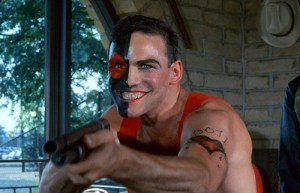
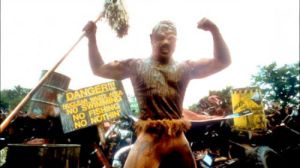
Today is National Cheese Curd Day (10/15) and cheese curd is basically immature cheese that hasn’t gone through any proper process. That’s kinda how I view Troma movies, films shot, cut raw, and served to the masses as unrefined horror. It’s definitely an acquired taste. The Toxic Avenger is a story of a bullied young man who gains superhuman strength after falling into a vat of toxic waste. The new mop-carrying hero promptly sets out to get revenge on those who tried to kill him, but also manages to clean up his small town of Tromaville, by getting rid of the bad guys and corruption along the way.
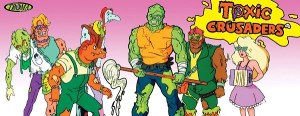
Directed by Michael Herz and Lloyd Kaufman, who also helped write and produce the film, The Toxic Avenger was panned upon its initial release but gained a strong cult following after being the featured midnight show at a popular movie house in Greenwich Village in 1985. The rest is history. Troma Entertainment went from making campy sex romps to campy horror, building a franchise of Toxic Avenger movies, which spawned five films and even a short-lived cartoon television series.
Armed with a specialized in a brand of satire, Troma effectively exaggerated the issues of the 80s drug-fueled excess, gym craze obsession, raging crime, political corruption, and clear class divisions, while serving up a satisfying revenge fantasy. The Toxic Avenger is campy, it’s gory, it’s silly, and may have played on stereotypes of the time, but once you swim through the bloodsplatter and Aquanet cloud, the Toxic Avenger is just as heartwarming as any of those John Hughes teen comedies of the 80s, and it had a lot to say about teen bullying. The Toxic Avenger isn’t the best-looking superhero on the planet but he sure is the hero the world needs.
These movies are so painstakingly 80s, they serve as a tubular tribute to both spandex and bloodsplatter.
The Chopping Mall (1986)
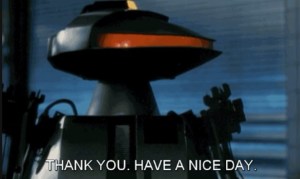
The fear of machines taking over and destroying mankind was all the rage in 80s, and Chopping Mall delivered feathered hair and killer lasers in spades. One-time protégé of B-movie king Roger Corman, Director Jim Wynorski kicked off a long career of B-horror movies and exploitation films, with this story about of group of mall employees partying after hours, only to find themselves the target of the mall’s new nighttime security system. I’m sure the movie had some meaningful message about not having sex in furniture stores and trusting machines to do a man’s job, but who cares, we came to see robots vs. humans!
These formidable Dalek-looking knock-offs rack up a kill count that could make the Terminator proud. They start by impaling a couple of techs and electrocuting a night-time janitor, played by character actor and Corman alum, Dick Miller, before moving on to our horny co-eds, played by a cast of hot 80s hopefuls, including Kelli Maroney, Tony O’Dell, and the legendary Barbara Crampton, in one of her earliest roles. Our spunky protags fight back with Molotov cocktails, flares and propane tanks, but ya know, bad bots and their neon lasers gotta steal the show.
Honestly, most of the special effects are as cheesy as the gratuitous boob shots, but one death does stands out as unbelievably gory, even by today’s blood-thirsty audience standards. It wasn’t as well done as say, Scanners, but it probably was the highlight of Suzee Slater’s career. All and all, Chopping Mall isn’t the best killer robot movie in the world, but I think true horror fans will appreciate it, besides, once Hollywood figured out how to make heads explode, even bad 80s B-flicks got a little more interesting.
Check out this stunning new digital zine from the creative talents of The Samhain Society, designed by Jackie Cheuvront of Eclipse Afterglow Studios and edited by Miranda Enzor of Spooky Little Halloween, featuring a collection of artworks, DIY projects, recipes, short stories, and more!
I am so honored to be part of such a creative collaboration with the most talented group of artists, writers and creators in the Halloween community. Click on link below or the picture.
Summer is always a rough season. Summer combined with the Corona virus lockdown is almost unbearable, but being stuck inside doesn’t have to be torture. I found these five low budget gems, definitely better than expected, that should satisfy your horror movie cravings.
We Summon the Darkness (2019) Service: Netflix
“There’s a lotta evil out there.”
For anyone’s who has ever worn a leather vest over a jean jacket, sported big feathered hair, or been bullied for listening to Ozzy or Slayer, all over the misguided belief that heavy metal is Satan’s music for devil worshippers, this one’s for you. Set in the 80s, this low-key thriller about three victims falling prey to a murderous cult with diabolical intentions isn’t particularly scary or gory, but it definitely harkens back to those old glossy B slashers that the studios used to churn out. The movie stars a gaggle of Hollywood’s brightest teen stars, led by Alexandra Daddario, and Johnny Knoxville, surprisingly right at home, playing a smarmy televangelist. The energy is high and acting is decent, honestly though, absolutely nothing else stands out here. Both the plot and the twists are totally predictable, it’s a little hard to tell if that’s by design or not. If I was one of the filmmakers, I’d get all meta and say, ‘oh yeah, it was supposed to be that way.’ People really enjoy homages, and stickin two giant middle fingers up to the real evil in the world, those big greedy corporate churches, for lying to the world about great music, using the lord’s name in vain, and besmirching religion. That, plus a bitchin’ soundtrack, and heavy metal couture, so 80s, you can almost smell the AquaNet, there are worse ways to spend a Saturday night.
Spring (2014) Service: Shudder
“I gotta make sure you’re the kinda crazy I can deal with.”
There aren’t too many well-made horror romances out there in the world, but this movie is in top ten. Spring, the story of grieving young man who finds love with a mysterious woman, while on a vacation in Italy, is just as refreshing as its name sounds. It’s simply a beautiful movie, everything from the strange Lovecraftian story to the incredible cinematography, and the dark, creepy suspense to the blossoming love between two strangers. What makes the film work, besides getting lost in charming scenery of Southern Italy, is the chemistry between the leads Lou Taylor Pucci and Nadia Hilker, it’s sweet, like saccharine, yet, definitely filled with a touch of danger and mystique. Their romance moves a little fast and even seems unrealistic, but if you factor in love at first sight (hey, it can happen), and remember the vulnerability of a lonely, grieving, inexperienced young man, it becomes real easy to understand why he would be attracted to an alluring, beautiful, mystical 2000 year old creature. It’s almost sad to watch her toy with him so effortlessly, then again, the boy is as impulsive as he is lost. A violent episode in the film’s beginning shows he’s far from a perfect hero and they might just be morally matched. As for the girl and her “condition”, well, you’ll just have to go watch the movie to see if her intentions are pure or not.
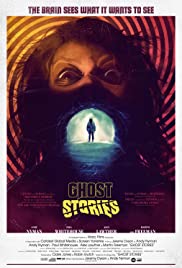
Ghost Stories (2017) Service: Hulu
“Things are not always as they seem.”
This movie about a skeptical professor and paranormal debunker is a cleverly disguised anthology from IFC Midnight, turns out to be one of the scariest movies that I’ve seen in a long time. Triple threat writer-director Andy Nyman stars as the wry skeptic investigating the disappearance of his hero mentor. Once he finds him, he is then tasked with looking into the old man’s three most disturbing cases, which brings the professor on a terrifying journey of self-discovery. Nyman, along with co-creator Jeremy Dyson based their script off their hit theater show of the same name. The writing, cinematography and performances here are all phenomenal, in particular, Martin Freeman as a haunted banker, and in a mystery role, that I won’t give away. Ghost Stories makes good work of jump scares and sports some deep Hammer vibes, paying homage to numerous horror films, so it’s not inventing the wheel or anything, just making really good use of the tools from the tool box. Sometimes, that’s all a proper horror film needs.
One Cut of the Dead (2017) Service: Shudder (Japanese subtitles)
“One take, no cuts. With one camera from start to finish.”
Shin’ichiro Ueda’s brilliant feature debut is a bit of movie inception. The movie starts off as a seriously cheesy low-budget zombie movie about an indie film crew filming a zombie movie in an abandoned warehouse, when suddenly, they’re attacked by real zombies, much to the director’s delight. If you’re still watching by the time the credits roll about 37 minutes in, yes, you read that right, boy, are you in for a treat! As you’re sitting there wondering ‘what the hell was that?’ a new movie starts. Well, sort of, it’s a flashback, and all good things to those who wait. One Cut of the Dead isn’t really a cheesy low-budget zombie film, it’s a hilarious meta-satirical comedy about filmmaking, including the backstage antics of producing live television. There are a ton of references to zombie movies and lots of gore and screaming, of course, but, the real prize here is the storytelling. One Cut features a strong message about the collaborative filmmaking process, and the resourcefulness, courage and heart it takes to be in the entertainment business. I guarantee, by the third act, you’ll forget all about those 37 minutes wasted in the beginning and cheer on the film crew’s spirited efforts to make their zombie movie.
Blood Quantum (2019) Service: Shudder
“Every one of those motherf****** is a time bomb.”
Blood Quantum is essentially zombies on a modern-day reservation. You get all the blood-thirsty ravaging undead and pensive natives struggling to survive day-to-day, while reconciling their anger, resentment, and fears. Writer-director Jeff Barnaby channels his inner Romero and delivers biting social commentary on real life native troubles by drawing parallels to surviving in the zombie apocalypse, thus, immediately making it a better than average zombie story. Life on the reservation hasn’t improved, but it hasn’t necessarily deteriorated either. The white man is still trying to kill us. Same shit, different millennia. A little closer to the heart, there’s nice family drama subplot involving a wayward son named Lysol, wonderfully played by Kiowa Gordon. Lysol is one complex dude. He’s angry and alluring, righteous, and terrifying, and I don’t think it’s a stretch to say he represents a lot of young native men across the North America. Sadly, in a film filled with quirky interesting characters, Lysol is one of the few fleshed out characters. Dropped plot points involving back stories is just one of tiny problems that all add up over time, keeping the film from being truly great. I read director Barnaby wore several post production hats to ensure he told the story he wanted to tell, but I can’t help but wonder what the film could have been, if only it had a bigger budget and better editing. Despite its obvious flaws, this is a solid horror movie with nice cinematography, comical one-liners, ranging from cheesy to endearing, and plenty of zombie action and bloody carnage.














 Halloween Horror Haiku
You must be logged in to post a comment.